
Eros Narrative Reprocessing Therapy (ENRT): Returning the Erotic Self to the Center of Trauma Healing (Parts V, VI & Conclusion)
- Tony Halligan
- Nov 28, 2025
- 9 min read

PART V: MY BOOKS AS CASE STUDY
The Drakaina Blood Saga as Therapeutic Architecture
Earlier, I traced the origin of ENRT through my own trauma history. Here, I trace it through my books, which are the symbolic architecture my psyche built long before the method had a name.
My books are not simply epic fantasy with erotic elements, they are precision-built narrative machines (intended in a twelve-part series) designed to metabolize trauma through symbol, archetype, erotic blueprinting, and recursive character mirrors.
To the casual reader, the erotic scenes may appear lush, immersive, or emotionally charged. But to those with clinical eyes, they reveal something far deeper.
They are ENRT in action. Every erotic moment in The Drakaina Blood Saga was crafted with:
emotional realism,
somatic attunement,
symbolic mirroring,
power re-mapping,
boundary repair,
agency restoration,
and archetypal integration.
These scenes are not written for titillation or gratuity; they are written for integration and reclamation. Essentially, I was performing ENRT before ENRT had a name.
Because narrative is the language of the erotic psyche, the page becomes the most neurologically precise healing environment available for erotic trauma. What healed me through fiction can heal others through structure: ENRT translates the same symbolic architecture into a clinical process any survivor can use, regardless of genre, aesthetic, or background.
What emerged was not fantasy overlaid on trauma but transformation grounded in neurobiology, enacted through imagination where the wound was born.
How the Erotic Scenes Functioned as My ENRT
When I wrote these scenes, I was not just creating fiction, I was rewriting the erotic imprint that childhood trauma fractured.
Each time I stepped into an erotic scene on the page, I engaged:
1. Symbolic Displacement
Characters held the emotional weight I could not yet hold directly. Their bodies became symbolic stand-ins for my wounded erotic self.
2. Agency Reclamation
In trauma, I had no choice. In narrative, every moment was choice-driven.
Who touches whom.
Who initiates.
Who sets the pace.
Who says yes.
Who says no.
Who yields, and why.
Who protects.
Who is protected.
Every narrative decision was a neurological correction to a wound that once involved total powerlessness.
3. Erotic-Somatic Reconsolidation
Pleasure, touch, desire, safety, and connection—all re-mapped in fiction first, where the limbic system could approach them safely.
4. Shame Dissolution
Writing allowed me to feel desire without collapse, to experience erotic charge without shame, and to integrate the erotic self without moral fear.
5. Archetypal Reorganization
My characters carried the wounded fragments, allowing me to:
take back what was stolen,
return what was never mine to hold,
transform what once terrified me,
integrate what once fragmented me.
This is the exact architecture ENRT formalizes.
What Parts of Me Healed as I Wrote Them
Writing the erotic scenes healed wounds that no therapist, no session, no modality ever reached. Because trauma did not live in my words, but in my imagination, bodily memory, and erotic blueprint.
Through ENRT (performed intuitively through writing), I restored:
• Erotic Agency
The right to choose.
The right to want.
The right to stop.
The right to surrender by choice rather than by force.
• Erotic Identity
Trauma collapsed my erotic self into silence. Yet story returned it to me with voice, shape, power, and coherence.
• Erotic Sovereignty
I re-authored the “I” that trauma tried to overwrite.
• Erotic Safety
I rebuilt a world where the body could feel sensation without terror.
• Erotic Imagination
The place trauma hid finally reopened.
• Erotic Self-Compassion
Shame dissolved where the story gave me beauty instead of disgust, agency instead of silence, and connection instead of fragmentation.
• Erotic Meaning
I learned what desire means when it is mine, not inherited nor forced or shaped by trauma.
How Each Erotic Scene Maps Onto a Wound
One of the most profound discoveries of ENRT is that erotic scenes can be diagnostic maps of trauma, and healing rituals when written consciously.
In The Drakaina Blood Saga, my scenes map into:
1. The Protector Archetype
Wound: I was unprotected as a child.
Healing: Characters who protect, shield, guard, or hold space for another become symbolic reparations to the limbic system.
2. The Forbidden Archetype
Wound: Trauma fused desire with danger and shame.
Healing: Forbidden dynamics written with consent, clarity, and sovereign power rewire “danger = desire” into “desire = chosen.”
3. The Surrender Archetype
Wound: Childhood trauma involved forced surrender.
Healing: Scenes where surrender is voluntary, grounded in safety, trust, and reciprocity, rewrite the imprint entirely.
4. The Power Archetype
Wound: I lost all power in trauma.
Healing: Erotic power, shared power, and power held with integrity restore the missing architecture of agency.
5. The Reclamation Archetype
Wound: Trauma stole ownership of my body and desire.
Healing: Erotic scenes of reclamation, where characters claim themselves, their pleasure, and their voice, fed my nervous system the truth it never received.
6. The Mirror Archetype
Characters who see one another fully become symbolic mirrors for the erotic self that was once unseen, denied, or silenced.
7. The Integration Archetype
When erotic scenes end in connection, grounding, coherence, or mutual presence, the erotic self learns a new ending.
Trauma scripts end in fragmentation, but ENRT scripts end in coherence.
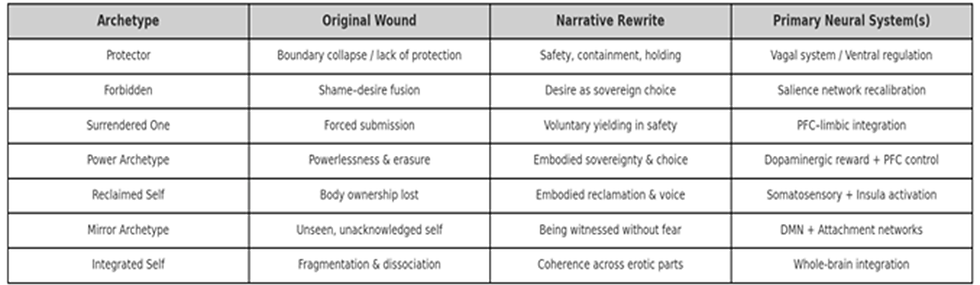
Figure 3. ENRT Archetypal Mapping: Each erotic archetype corresponds to a core trauma wound, a symbolic narrative rewrite, and a neural system involved in erotic healing. This mapping operationalizes trauma-coded erotic expression into a clinically actionable structure.
How the Archetypes Mirror Trauma Recovery
The Protector: repairs abandonment wounds.
The Forbidden: disentangles desire from shame.
The Surrendered One: transforms forced submission into chosen softness.
The Powerful One: reclaims agency through embodied sovereignty.
The Reclaimed Self: rewrites the identity trauma tried to assign.
The Lover Who Sees: restores the lost experience of being known without threat.
The Integrated Self: emerges when the erotic archetypes no longer war with each other, but find coherence inside the psyche.
The Core Truth
My book series is not erotic fantasy, it is trauma integration disguised as epic fiction. My erotic scenes are not for shock or entertainment, they are sacred neurological interventions rooted in:
symbolic cognition
memory reconsolidation
somatic attunement
archetypal repair
erotic blueprint restructuring
narrative identity rebirth
The Drakaina Blood Saga is ENRT woven into myth. It healed me. And soon, it will help heal others.
But my books are only the first expression of this architecture. ENRT is larger than any single story or author; it is a framework that can be taught, researched, adapted across cultures and clinical contexts, and eventually embedded into training, supervision, and digital tools.
Part VI looks ahead to that future, to the evolution of ENRT from one survivor’s symbolic survival strategy into a full clinical lineage and emerging field of erotic trauma repair.
PART VI: THE FUTURE OF ENRT
A new paradigm is emerging in trauma therapy. One that does not sidestep the erotic self, or treat it as clinical taboo, but recognizes it as the very architecture where sexual trauma is stored.
The next decade of trauma treatment will be shaped by modalities that integrate:
neuroscience
narrative identity
symbolic cognition
somatic intelligence
erotic blueprinting
epigenetic mapping
ENRT stands at this intersection.
It is not simply a therapeutic technique, but the beginning of a new clinical era. What follows is the path toward ENRT becoming a globally recognized, survivor-centered, research-supported framework.
Training Clinicians: A New Standard of Integration
ENRT requires clinicians who are not only trauma-informed, but symbolically literate, erotically integrated, and emotionally coherent.
To practice ENRT, clinicians must master:
• symbolic processing
• erotic archetype theory
• narrative cognition
• somatic attunement
• limbic reprocessing
• shame-sensitive dialogue
• boundary mastery
But ENRT demands more than technical skill. It demands a fully integrated clinician.
Clinician Integration Is Ethical, Not Optional
Because ENRT works in the erotic imagination, which is a territory many clinicians have never explored in themselves, the unintegrated clinician becomes a clinical hazard.
This does not occur out of malice, but because:
• Their erotic shadow will distort interpretation
• Their discomfort will constrict the narrative
• Their shame will reinforce the survivor’s shame
• Their dissociation will trigger dissociation
• Their unprocessed archetypes will bleed into the work
In ENRT: the clinician is the container. Thus, if the container is fractured, the process cannot be safe.
This is the evolution of trauma ethics. The clinician must be internally coherent in order to safely guide incoherent trauma.
A Scalable Training Architecture
Each level of ENRT training builds on increasing depths of symbolic literacy, erotic attunement, and trauma integration capacity.
Level I: Foundational ENRT Practitioner
Focus: Safety, stabilization, and symbolic literacy
Practitioners learn:
• Erotic narrative mapping
• Symbolic erotic cognition (archetypes, roles, fantasy structures)
• Narrative pacing to maintain regulation
• Somatic attunement and grounding protocols
• Shame-sensitive inquiry and non-pathologizing language
• Identifying trauma-coded desire patterns safely
Outcome: Clinicians can facilitate the outer edges of erotic reprocessing while maintaining optimal safety windows.
Level II: Advanced ENRT Practitioner
Focus: Direct engagement with the erotic imprint
Practitioners learn:
• Archetype-based assessment and diagnostics
• Tracking limbic shifts through narrative
• Erotic blueprint interpretation
• Countertransference + erotic shadow regulation
• Depth reprocessing and symbolic rewrites
• Working with lineage-based erotic trauma
Outcome: Clinicians can navigate deeper symbolic activation while maintaining agency, clarity, and coherence.
Level III: ENRT Master Practitioner
Focus: Leadership and clinical stewardship of the field
Practitioners learn:
• ENRT clinical supervision skills
• Teaching and training future practitioners
• Group ENRT facilitation + community models
• Research design + clinical trials
• Institutional program development
Outcome: Clinicians become the architects of the next evolution of ENRT, expanding the field through research, training, and innovation.
This structure supports:
• licensure alignment
• certification pathways
• peer-review credentialing
• continuing-education standards
• global implementation readiness
Importantly: ENRT training is a living architecture, just like the therapy itself. Therefore, as science evolves, the training should evolve with it, expanding in precision and depth alongside the field itself.
This is how ENRT matures into a global modality.
THE VISION: Where ENRT Is Going
ENRT is poised to become:
a new lens for understanding erotic trauma
a survivor-led movement
a global clinical training curriculum
a research-validated therapeutic field
a licensed discipline with recognized standards of care
More than that:
ENRT restores the exiled dimension of trauma. It treats the erotic wound as a symbolic, somatic, generational, narrative, and neurobiological reality—a clinically central phenomenon worthy of its own field.
What began as the private repair of one survivor now stands as a scalable architecture capable of reshaping trauma care worldwide. Survivors have carried this wound in silence for generations.
Now, they finally have a method that:
• speaks the language their trauma speaks
• heals in the dimension where the trauma lives
• returns ownership of desire, body, and self
ENRT is the paradigm shift the field has been missing. The future of trauma therapy will be written in the language of Eros, and ENRT is its first lexicon.
Conclusion: Returning the Erotic Self to the Center of Healing
For decades, sexual trauma has been treated everywhere except at the root of where it lives. Therapies address memory, sensation, behavior, and thought yet leave the symbolic core where the wound embeds itself untouched: the erotic imagination.
This paper has argued that:
• Sexual trauma fractures the erotic self at the level of symbol and identity
• Survivors reenact trauma-coded desire not because they want to, but because the wound seeks completion
• Existing therapies lack the language, tools, and architecture to heal the erotic psyche
• Narrative is the operating system of the erotic self
• Memory reconsolidation through symbolic erotic narrative restores agency, identity, and safety
• ENRT formalizes this process into a clinically replicable framework
The erotic self is not an afterthought. It is the seat of power, pleasure, voice, and autonomy—and therefore the first target of sexual violence. If we avoid this territory in treatment, the trauma survives.
ENRT restores access to the place trauma exiled from awareness and gives clinicians a method to guide survivors home. It reframes erotic expression not as dysfunction or pathology, but as encrypted survival data, containing the blueprint for its own healing.
When we say erotic trauma requires erotic language, we are not being provocative, we are being accurate.
Survivors deserve:
• A therapy that speaks the language their trauma speaks
• A method that heals in the dimension where the trauma lives
• A future where their desire is not feared, but reclaimed
This is not only a clinical necessity, it is a cultural one. The shame that silences survivors also sustains the systems that harmed them. Healing the erotic self is rebellion, reclamation and liberation.
ENRT is the return of the erotic self to the center of trauma recovery, not as taboo or pathology but as truth. The next era of trauma therapy belongs to Eros, and to those brave enough to follow survivors into the place where the story began.
© 2025 Anthony Halligan. ENRT™ (Eros Narrative Reprocessing Therapy) is a trademark of the author. All rights reserved. This document may be cited or referenced with appropriate attribution. For inquiries, permissions, or training opportunities, contact: www.anthonyhalligan.com


Comments